
This framework is intended as a guide to integrating decision making around extreme event impacts into on-farm risk management. Its aim is to help establish a process to support climatically risky decision making and effective management for higher priority extreme event risks of most consequence to the Southern Red Meat and Dairy industries. It does not aim to cover usual weather and climate variability and associated decision making, although there is likely cross application. The following steps take you through the process using an example.
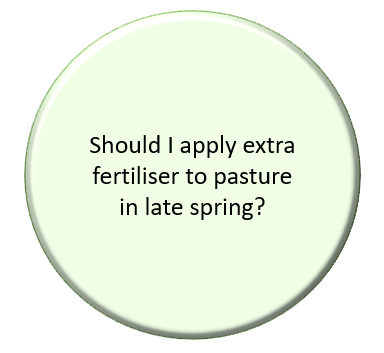
This example considers the decision: “Whether to defer/reduce fertiliser application (avoid wastage)” which was a climatically sensitive decision identified by reference group members from both the Dairy and Southern Red Meat industries.
Fundamentally, it considers whether to apply N fertiliser to pasture or not.In this case we specifically consider the decision whether to apply N in late spring, considered a risk due to poor N responses in dry years. This risk may appear lower if a wetter late spring is predicted. Prior to trying to quantify the decision options for the question in point, Hayman and Mudge (2021) recommend verbal decision analysis (VDA) which can be undertaken using a simple decision tree or table. This type of decision analysis flows from the idea that, the logic of those difficult risky decisions and potential outcomes can be deconstructed into attributes that result in outcomes of preference. Doing this helps create a balanced view of the risks and rewards of each possible action under consideration. The basic flow of either is
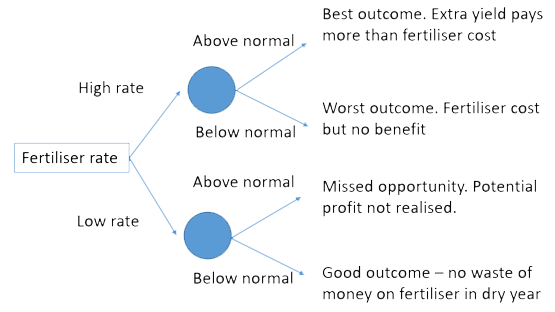
Figure 1 Example decision tree analysis re late season N fertiliser application (Hayman 2021).
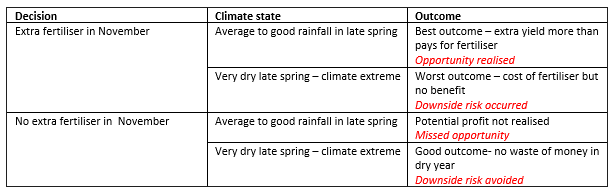
Table 1 Example decision table analysis from Hayman 2021.
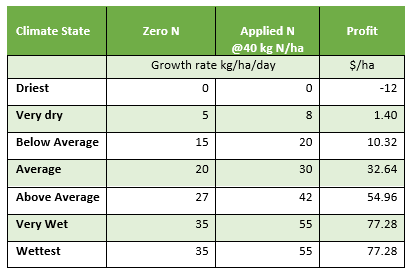
Following Hayman and Mudge (2021), and using their spreadsheet, the yields for the higher-profit, higher-risk option and the lower-profit, lower-risk option were estimated across different climate states from Driest to Wettest (Table 2 column 1 – note deciles could also be used to represent climate state). The yields accounted the estimated pasture growth rate kg DM/ha/day for both fertiliser options along with the dry matter intake and carry over fertiliser (later pasture growth).
The assumptions were:
The biophysical estimates against climate state for each option are also shown in Table 4 with estimated profit provided in the final column.
Note, the values include accounting for DM yield responses including potential for N carry over (i.e. minimal loss of unused N, as shown in the MPfN project).
Table 2 Example decision table analysis from Hayman 2021.
The two graphs below (Figures 2 and 3) present the outcomes from the biophysical and economic information against the normal climatology (i.e. an equal chance of any of the wet to dry scenarios – Figure 2) and a revised wetter than average predicted climatology (Figure 3). The bar charts at the base of each graph show the climatology distribution (red, yellow, green) with the black lines indicating the mid-point of each.
The Y axes are profit ($/ha) and the X axes represent the climate state: 10 deciles of growing season rainfall from driest to wettest. Advancing along the horizontal axis, from left to right, progresses from the driest climate state (0) to the wettest climate state (100).
The ‘Zero N’ (No Topdress) option is the straight blue line at 0 (no cost) and the ‘Applied N’ (Topdress) option is the brown line and is the loss or profit of the N application relative to the Zero N option.
Each graph provides the possible outcomes over the climate range
Hover over image to enlarge.
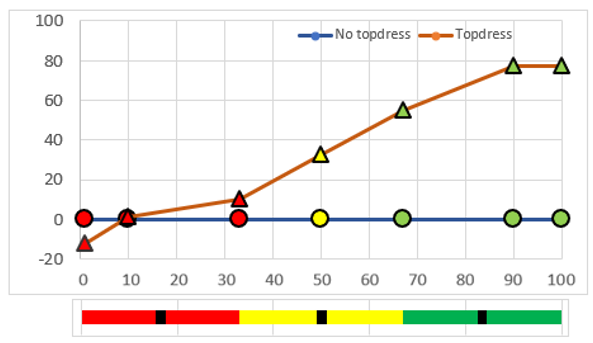
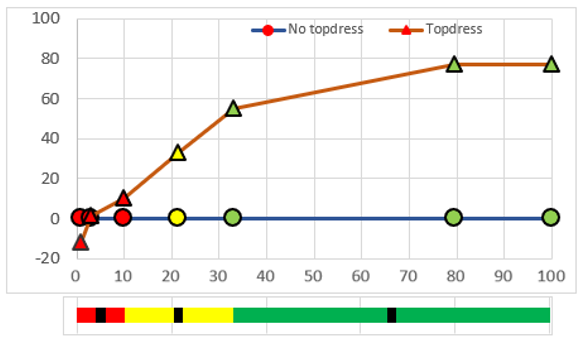
| Figure 2 Decision outcomes against normal climatology. | Figure 3 Decision outcomes against wetter than average climatology. |
| Risk Framework supporting extreme event on-farm decision making | As part of the FWFA project, industry specific guides aiming to integrate extreme event decision making into on-farm risk management were developed. They aim to establish a process supporting climatically risky decision making for and effective management of, higher priority extreme event risks of most consequence to the industry of focus. |
| FWFA - On-farm risks for Southern Red Meat Producers during extreme heat events | Under the FWFA Project, consultation with Southern Red Meat industry producers indentified and prioritised the extreme events of most consequence to their industry and business. Identified heatwave on-farm impacts across identified vulnerability categories impacting the development/production/quantity and/or quality of pasture-based livestock production is presented on this page. |
This project is supported by funding from the Australian Government Department of Agriculture, Fisheries and Forestry as part of its Rural R&D for Profit program in partnership with rural Research and Development Corporations, commercial companies, state departments and universities. Meat &Livestock Australia (MLA) is responsible for the overall management of the project.
