
Managing extreme event risks is a challenge for Australian Southern Red Meat farmers. To effectively manage risks associated with extreme events on-farm, the operations/activities and assets that are vulnerable or sensitive and at risk from an extreme event need to be identified, prioritised and mitigated.
This framework is intended as a guide to integrating decision making around extreme event impacts into on-farm risk management. Its aim is to help establish a process to support climatically risky decision making and effective management for higher priority extreme event risks of most consequence to the Southern Red Meat industry. It does not aim to cover usual weather and climate variability and associated decision making, although there is likely cross application.
The first step in identifying the on-farm risks and impacts associated with extreme events is to define it as part of the risk universe for your location. This is a straightforward listing of all possible risks and impacts associated with extreme events that you are likely to/have experience (d), at your location/in your business. Examples include short duration (e.g. heatwaves, flood events, frost, extreme cold) and extended (drought, extended wet) events. Building an identification list is uncomplicated, particularly for well-established and long running on-farm operations.
Following the identification of your climate and weather risks you need to assess or evaluate the probability of occurrence, frequency and magnitude of exposure to those.
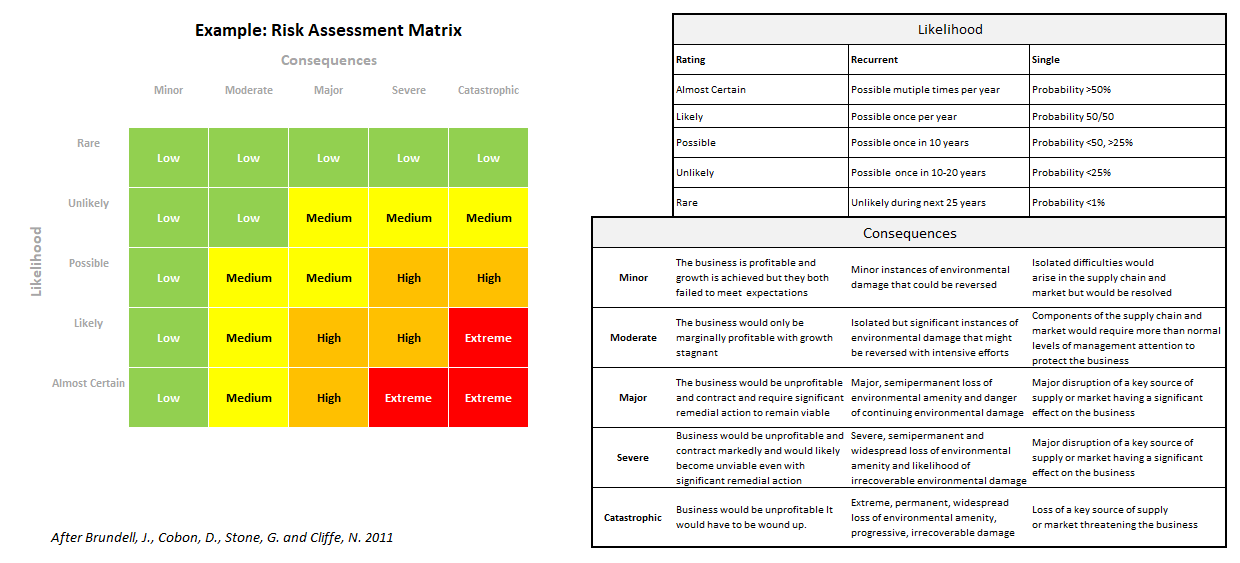
Typically, risk assessment/evaluation combines the likelihood of the extreme event and the consequences of that event. Given the uncertainty associated with the timing, magnitude and frequency of specific extreme events plus variability due to location, assessment of risk and impacts often employs qualitative techniques and tools such as a risk assessment matrices, however quantitative assessment is possible for breeding and stocking via calculator tools. Table 2 below represents the fundamental structure of risk assessment matrix (note these can also accommodate quantitative evaluation where figures are available). These assessment matrices can be employed in a variety of ways to appraise impacts and vulnerabilities.
Table 2 A example risk assessment matrix (after Brundell et al, 2011).
In short, the risk assessment process involves:
From an analytical and managerial perspective, once risks have been assessed and prioritised, decisions regarding the treatment to address the potentially adverse consequences of those risks need to be taken. This involves identifying the options (responses/actions) available and making key decisions around which, when and how to implement those. At a high level, those treatments for climate and weather on-farm risks can be classified as operational, tactical and strategic. The distinction between these decisions relates to whether they have short term or long term effects to the business, however each may manage the risk across four generalised mechanisms:
Documenting the risk assessment process in a particular form is personal choice. Here you can test a draft simple risk assessment tool to help the build a customised identification and assessment of your on-farm climate and weather risks and impacts, along with actions to manage those.
You may download this excel spreadsheet tool to assist you in identifying, assessing and prioritising your on-farm risk associated with extreme climate/weather events. Based on the information you input,the tool will populate an extreme event risk assessment matrix (similar to the above example) as well as a vulnerability matrix. You can then identify and detail the management actions required to addess the risk as well as prioritise those actions based on the assessment.
As you complete the above, a quantitative snapshot of your on-farm extreme events risks will be presented on a report worksheet in the same workbook. Note:this is a draft version and is still awaiting feedback for further development.
Important climate-sensitive, tactical or operational decisions often need to be made when it is unclear how or whether to use uncertain climate information. This uncertainty increases the difficulty of reaching such a decision. There are numerous way to approach difficult decision making and most include breaking down the decision process. A logical process to approach climate risky decision making under uncertainty has been developed by Peter Hayman and Barry Mudge under the FWFA project. It aims to provide a sense of the outcomes of such a decision and where applicable, quantify the outcomes of the risky decision. Click here for details on the underlying process including learning about the Rapid Climate Decision Analysis (RCDA) framework.
| Rapid Climate Decison Analysis (RCDA) | Taking a closer look at specific climate risky decisions. This webpage outlines the underlying process of the Rapid Cliamte Decision Analysis framework. |
| Applying RCDA – an example for Southern Red Meat and Dairy producers | This webpage outlines the RCDA framework, followed by the application of it to a specific decision selected from those identified by the FWFA IRG. It steps the audience through the Rapid Climate Decision Analysis (RCDA) process using an example of whether to apply fertiliser (N) in late spring. |
| FWFA - On-farm risks for Southern Red Meat Producers during extreme heat events | Under the FWFA Project, consultation with Southern Red Meat industry producers indentified and prioritised the extreme events of most consequence to their industry and business. Identified heatwave on-farm impacts across identified vulnerability categories impacting the development/production/quantity and/or quality of pasture-based livestock production is presented on this page. |
This project is supported by funding from the Australian Government Department of Agriculture, Fisheries and Forestry as part of its Rural R&D for Profit program in partnership with rural Research and Development Corporations, commercial companies, state departments and universities. Meat &Livestock Australia (MLA) is responsible for the overall management of the project.
