The Bureau of Meteorology defines a heatwave as “three or more days in a row when both daytime and night-time temperatures are unusually high—in relation to the local long-term climate and the recent past.” (Bom1). Observations in Australia over the last 60 years show that:
Trancoso et al. indicate strong evidence of recent intensification of Australian heatwaves with their characteristics increasing more rapidly over Victoria, the Australian Capital Territory and New South Wales. No areas have shown decreasing trends. Projections of heatwaves indicate that, with a global warming of 1.5 to 2.0 °C their frequency may increase by 85% and with a global warming to 3.0 °C heatwave duration may last up to a month.
In Australia there is no singular temperature threshold defining a heatwave. The Bureau of Meteorology compares the forecast maximum and minimum temperatures for each three-day period in the coming week (e.g. Monday – Wednesday, Tuesday – Thursday) with the 'normal' temperatures expected for that specific location at that time of year, and to observed temperatures over the last 30 days.
The Bureau of Meteorology provides a heatwave service commencing in October each year here and extremes monitoring informatin here. New extreme event forecasting tools developed by the Bureau under the FWFA project can be found in the Climate Outlooks suite of products
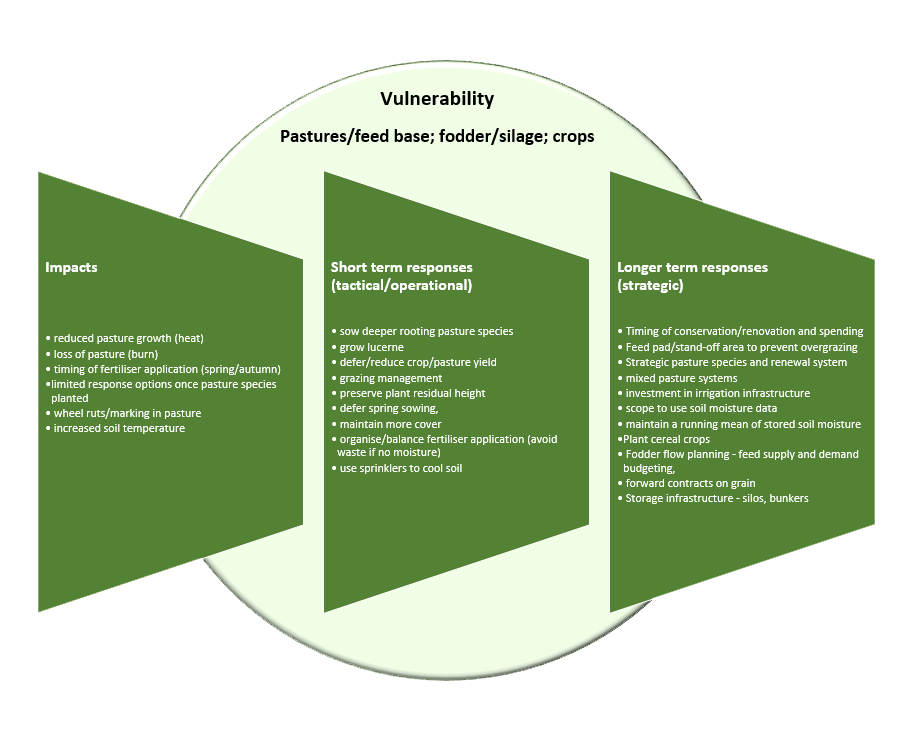
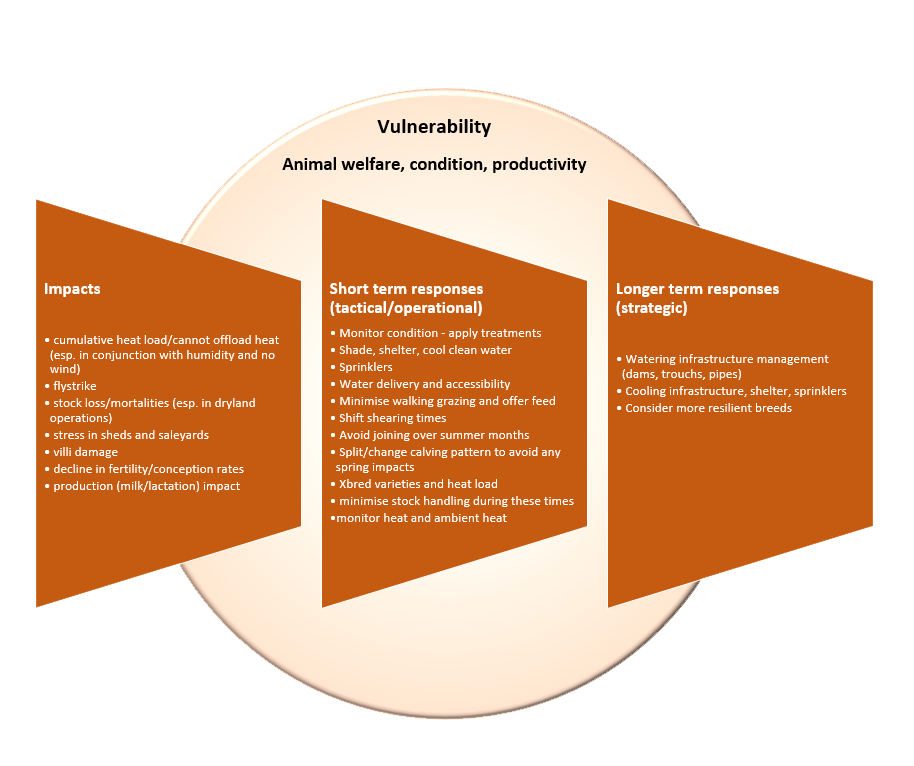
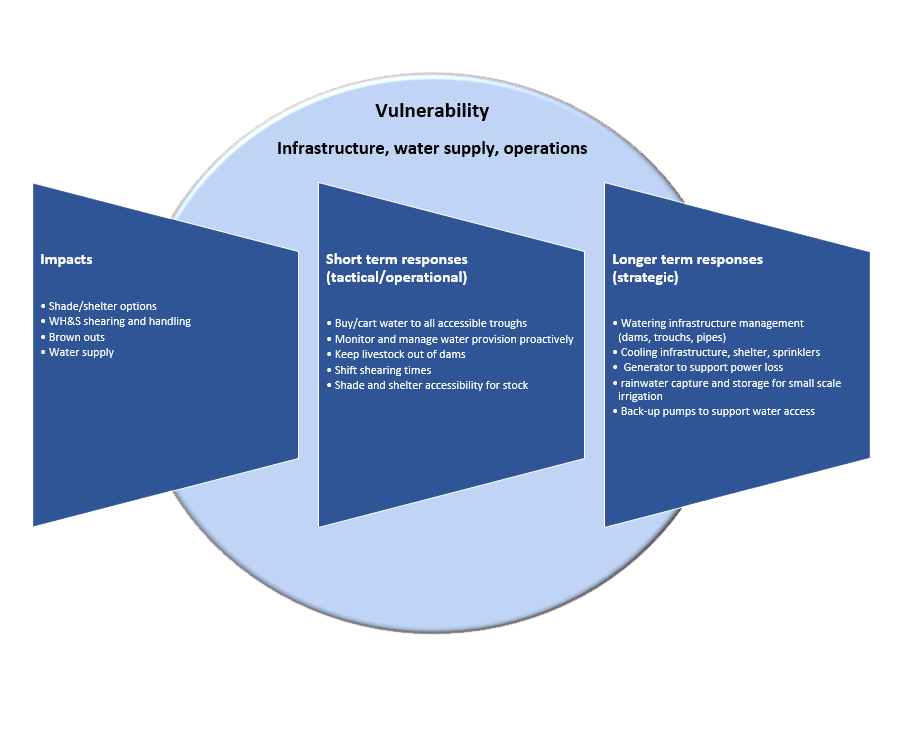
Under the Forewarned is Forearmed Project, a structured consultation process with Southern Red Meat industry Reference Group (IRG) members was undertaken to identify and prioritise extreme events of most consequence to the industry and business. The key categories in the farm business identified by the IRG members primarily fall into three broad groups:
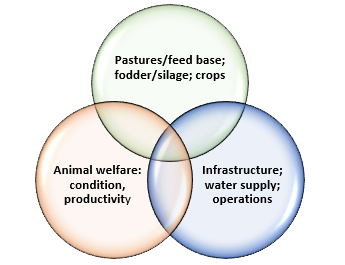
Following is information from those consultations, with noted on-farm impacts across identified vulnerability categories impacting the development/production/quantity and/or quality of pasture-based livestock production. Shorter term (tactical and operational) and longer term (strategic) response actions to manage risks are noted. This is not exhaustive and links to further resources and relevant information are provided.
Hover over image to enlarge
| Risk Framework supporting extreme event on-farm decision making | How to establish a process supporting climatically risky decision making for and effective management of, higher priority extreme event risks of most consequence to the industry of focus. | Rapid Climate Decison Analysis (RCDA) | Taking a closer look at specific climate risky decisions. This webpage outlines the underlying process of the Rapid Climate Decision Analysis framework. |
| Applying RCDA Framework – an example for Southern Red Meat and Dairy producers | This webpage outlines the RCDA framework, followed by the application of it to a specific decision selected from those identified by the FWFA IRG. It steps the audience through the Rapid Climate Decision Analysis (RCDA) process using an example of whether to apply fertiliser (N) in late spring. |
This project is supported by funding from the Australian Government Department of Agriculture, Fisheries and Forestry as part of its Rural R&D for Profit program in partnership with rural Research and Development Corporations, commercial companies, state departments and universities. Meat &Livestock Australia (MLA) is responsible for the overall management of the project.