
Often, Important climate-sensitive, tactical or operational decisions need to be made when it is unclear how or whether to use uncertain climate information. This uncertainty increases the difficulty of reaching such a decision. This page explores a logical process to approach climate risky decision making under uncertainty and gain a sense of the outcomes of such a decision and where applicable, quantify the outcomes of the risky decision. Specifically, this uses the Hayman (2019) and Hayman and Mudge (2021) discussion paper including Rapid Climate Decision Analysis (RCDA) framework detailed HERE (this will eventually link to Peter's product). An outline of the Rapid Climate Decision Analysis (RCDA) framework is followed by the application of it to a specific decision identified by the Forewarned is Forearmed (FWFA) project industry reference group members.
The RCDA aims to work through climate sensitive decision information leading to outcomes in 30 minutes or less and is founded on three assumptions:
The entire RCDA process incorporates five steps as summarised in Figure 3 and employs a spreadsheet to work through the steps (download pdf here for further detail - to be provided by Peter Hayman).
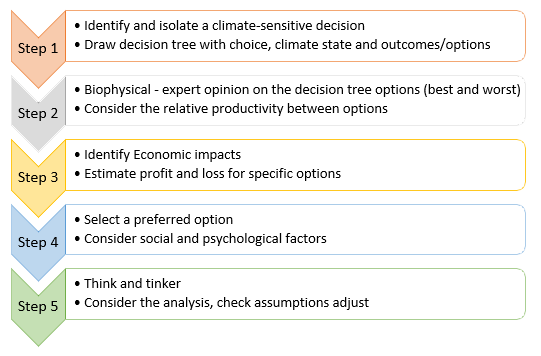
Figure 1 The steps involved in Rapid Climate Decision Analysis.
| Applying RCDA Framework – an example for Southern Red Meat and Dairy | This page steps the audience through the Rapid Climate Decision Analysis (RCDA) process using an example of whether to apply fertiliser (N) in late spring. |
| Risk Framework supporting extreme event on-farm decision making | How to establish a process supporting climatically risky decision making for and effective management of, higher priority extreme event risks of most consequence to the industry of focus. |
| FWFA - On-farm risks for Southern Red Meat Producers during extreme heat events | Under the FWFA Project, consultation with Southern Red Meat industry producers indentified and prioritised the extreme events of most consequence to their industry and business. Identified heatwave on-farm impacts across identified vulnerability categories impacting the development/production/quantity and/or quality of pasture-based livestock production is presented on this page. |
This project is supported by funding from the Australian Government Department of Agriculture, Fisheries and Forestry as part of its Rural R&D for Profit program in partnership with rural Research and Development Corporations, commercial companies, state departments and universities. Meat &Livestock Australia (MLA) is responsible for the overall management of the project.
